$10 Off for New Buyers with Code 6YPYU5KC | US Free Shipping | Start from 1 Carton

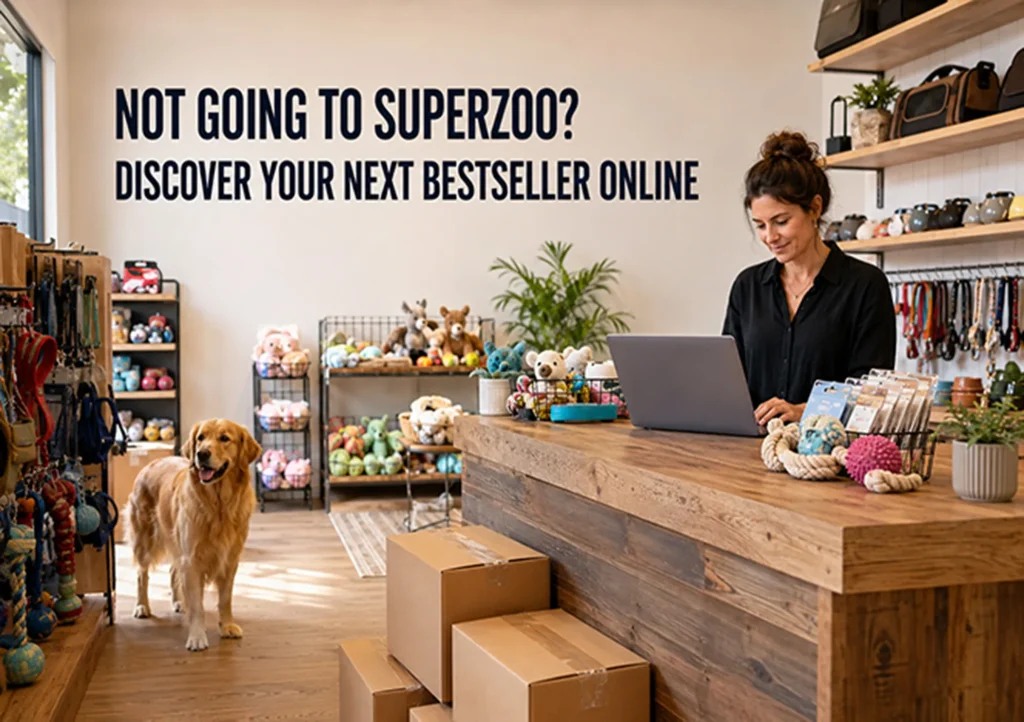
Not Attending SUPERZOO 2026? Source 2026 Trending Pet Bestsellers Online

The Short Answer: You Do Not Need to Be in Las Vegas to Keep Discovering What to Sell

SUPERZOO 2026 brings thousands of pet professionals, suppliers and products together in Las Vegas. Its official show-floor information highlights more than 1,100 exhibitors, 1,000+ product debuts, 22,000+ pet professionals and over 350,000 square feet of exhibition space. In other words, product discovery is one of the biggest reasons the industry pays attention to SUPERZOO.
But not every pet store owner, groomer, online seller, trainer, breeder or new entrepreneur can take several days away from work and travel to Las Vegas.
Fortunately, the underlying business need does not disappear just because you are not attending the show.
You still need to answer the same questions:
  • What pet products are gaining attention?
  • Which categories are worth testing?
  • What could become my next bestseller?
  • How much inventory should I risk on an unfamiliar product?
  • How quickly can I replenish a winner?
  • Can one supplier cover enough categories to make sourcing manageable?
That is where online pet wholesale becomes increasingly valuable.
At Petfairs, our view is simple: trade shows are excellent places to see what is happening in the industry, but retailers should be able to discover, test and reorder products throughout the year—not only during three days in Las Vegas.
The most practical sourcing model for a small pet business is therefore not necessarily “buy big when a trend appears.” It is:
Discover → Test → Measure → Reorder.
That shift is especially important in a pet market that remains large but increasingly value-conscious.
 

Why SUPERZOO Matters Even If You Are Not Going

SUPERZOO is more than a social event for the pet industry. It is fundamentally a product discovery and buying environment.
The official SUPERZOO show floor includes areas dedicated to pet retail categories ranging from dogs and cats to grooming, natural and health products, birds, reptiles, aquatic animals and other small pets. Its New Product Showcase also highlights areas such as grooming and wellness, enrichment, travel, home and lifestyle products, sustainability and smart pet technology.
That matters because it reveals what professional pet buyers are actually trying to accomplish.
They are not simply asking:
“What looks new?”
They are asking:
“What is worth putting on my shelf?”
Those are very different questions.
A product can be innovative without being commercially successful. A product can become popular on social media without producing healthy margins for a small retailer. And something that sells extremely well in one pet boutique may perform poorly in another because the local customer base, price point and pet population are different.
The real lesson to take from SUPERZOO is therefore not that every retailer must attend.
It is that continuous product discovery is essential to pet retail.
 

The Pet Industry Is Still Large—and Still Creating New Entry Points

The U.S. pet economy continues to demonstrate unusual resilience.
According to the American Pet Products Association’s 2026 State of the Industry Report, U.S. pet industry expenditures reached approximately $158 billion in 2025, representing 3.7% growth, and APPA projects spending to reach approximately $165 billion in 2026. APPA also reports that approximately 95 million U.S. households owned at least one pet in 2025.

U.S. Pet Industry Spending

Year U.S. Pet Industry Expenditure Change
2025 $158 billion 0.037
2026 forecast $165 billion +$7 billion
Forecast growth ~4.4%
Source: APPA 2026 State of the Industry.

Simple Growth View

2025 $158B ██████████████████████████████
 
2026 Forecast $165B ███████████████████████████████
 
A $7 billion increase in one year does not mean every pet company automatically succeeds. It does mean, however, that the underlying consumer economy remains substantial.
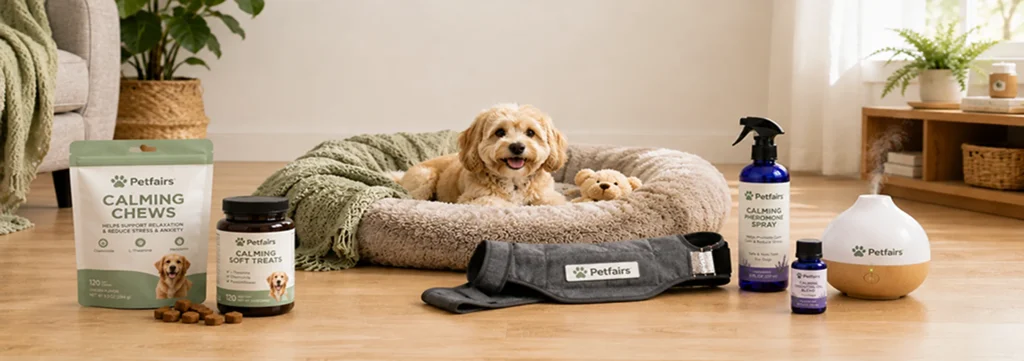
calm dog during storm
APPA also reports that cat ownership reached 53 million U.S. households, while dogs are present in approximately 53% of U.S. households. At the same time, APPA notes that pet owners are becoming more value-conscious and are adjusting budgets and shopping behavior.
For retailers, that creates both an opportunity and a warning.
The opportunity is obvious: millions of households continue spending money on animals they consider part of their families.
The warning is equally important: consumers are becoming more selective.
Retailers therefore cannot simply stock more.
They need to stock smarter.
 

Is the Pet Industry Really a “Blue Ocean”?

Our view is that the pet industry still contains significant blue-ocean opportunities, although it would be misleading to describe the entire industry as uncontested.
Dog food and basic pet supplies are obviously mature categories. Large chains, marketplaces and global brands already compete heavily in them.
But the pet economy keeps producing smaller underserved segments.
Examples include:
  • premium enrichment products;
  • specialty grooming accessories;
  • mobile grooming retail;
  • products for multi-pet households;
  • seasonal pet merchandise;
  • travel accessories;
  • products for birds, reptiles and small mammals;
  • subscription box products;
  • social-commerce-friendly pet products;
  • specialized products for trainers and breeders;
  • retail add-ons for veterinary clinics;
  • boutique accessories;
  • smart pet products.
This is where small businesses often have an advantage.
A national retailer needs categories capable of generating large-scale volume. A local groomer may only need 10 or 20 strong retail products that complement grooming appointments.
A major chain needs complex assortment planning. A social commerce seller might need five visually interesting items that demonstrate well on TikTok or Instagram.
A large distributor needs scale. A new pet boutique needs enough variety to learn what its customers actually want.
That is why we believe many of the best opportunities in pet retail now exist at the micro-category level, not simply at the level of “dog supplies” or “cat supplies.”
 

Who Actually Needs Online Pet Wholesale?

The phrase “pet retailer” can be misleading because the modern pet product buyer is much more diverse than a traditional pet store owner.
Petfairs primarily serves what we think of as small-business buyers and high-intent/prosumer buyers.
They may not need a container of one SKU.
They may not have a warehouse.
They may not employ a full-time sourcing manager.
But they still need wholesale economics.

Typical Online Pet Wholesale Buyers

Buyer Type What They Need Main Sourcing Risk
Independent pet store Broad assortment + frequent newness Overstock
Pet boutique Unique, visual, premium products Buying the wrong styles
Groomer / salon Retail add-ons Limited shelf space
Mobile groomer Compact, useful products Storage limitations
Online pet seller Variety + competitive pricing Slow-moving SKUs
Marketplace reseller Products with proven demand Margin pressure
Social commerce seller Visually demonstrable products Trend volatility
Subscription box seller Fresh recurring assortment Product repetition
New pet store owner Starter assortment Cash-flow pressure
Veterinary clinic retail corner Useful care products Low retail volume
Dog trainer Training and enrichment products Narrow demand
Breeder Functional products for multiple animals Buying retail repeatedly
Boarding/daycare business Durable, frequently used products High consumption
Local distributor Wholesale depth Supplier fragmentation
Shelter/rescue organization Practical supplies at scale Budget constraints
Multi-pet household Better unit economics Buying more than needed
The common denominator is not business size.
It is purchasing efficiency.
These customers want a better price than normal consumer retail but may not have enough demand to justify traditional factory-level minimums.
 

The Sourcing Gap Small Pet Businesses Often Face

This is one of the biggest structural opportunities we see in the pet industry.
Traditional wholesale frequently works best when the buyer already has volume.
Manufacturers want predictable production runs.
Distributors optimize cartons and pallets.
Large brands prioritize accounts capable of moving meaningful quantities.
That is economically understandable.
But it creates a gap.
Who serves the groomer who wants to add ten retail SKUs?
Who serves the new Shopify pet store that wants to test five categories?
Who serves the trainer who wants a small inventory of enrichment products?
Who serves the reptile enthusiast building a specialized e-commerce store?
Who serves the pet boutique owner who wants to try Halloween inventory without having January shelves full of unsold pumpkins?
These customers are too commercial for normal retail pricing but sometimes too small for traditional wholesale structures.
This is the gap online low-MOQ wholesale can fill.
Petfairs’ current model allows many products to start at one carton, with the number of pieces inside that carton varying by product. Petfairs describes this model as a way for businesses to test inventory without committing to traditional large factory orders.
 

What Does “Low MOQ” Actually Mean?

MOQ stands for Minimum Order Quantity, meaning the smallest quantity a supplier is willing to sell in a single order.
In traditional manufacturing, MOQs may be determined by production runs, packaging, material purchasing and labor efficiency.
Petfairs uses a one-carton MOQ model across much of its marketplace. One carton might contain 9 units, 14 units, 30 units or another quantity depending on the product and case pack. The exact carton composition is listed on individual product pages.
That distinction is important.
Low MOQ does not mean “buy one individual dog toy at wholesale price.”
It means:
buy enough to obtain wholesale economics without immediately committing to hundreds or thousands of units.
For a small business, that can dramatically change the risk equation.
 

Why Small-Batch Testing Matters More Than Chasing Trends

Consider two hypothetical retailers.
Retailer A believes an interactive pet toy will become a bestseller and immediately orders 500 units.
Retailer B tests a carton first, measures sell-through, gathers customer feedback and then reorders when demand becomes visible.
If the product succeeds, both can eventually increase volume.
If it fails, Retailer B has learned something at a much lower inventory cost.
That is why we prefer the phrase:

Test your way into a bestseller.

A bestseller usually cannot be reliably identified from appearance alone.
The retailer needs data.

Five Signals We Would Watch Before Scaling a Pet Product

Signal Question
Customer problem Does this solve a clear need?
Demonstration value Can shoppers understand it quickly?
Price-value fit Does the benefit justify the retail price?
Initial sell-through Are customers actually buying it?
Reorder signal Do sales justify another carton?
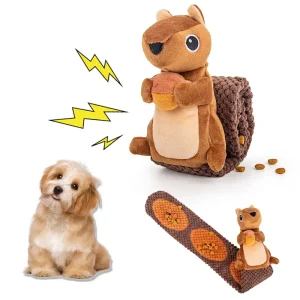
Interactive Squeaky Plush Squirrel Dog Chew Toy
The strongest products often perform well across several dimensions.
An interactive feeder, for example, may provide enrichment, slower eating and a visually understandable demonstration.
A travel water bottle solves an obvious outdoor problem.
A grooming tool can be demonstrated immediately.
A seasonal toy creates visual urgency.
Retail success often comes from these practical combinations of need + clarity + timing + price.
 

What Product Categories Are Worth Watching Around SUPERZOO 2026?

SUPERZOO’s current show-floor structure and New Product Showcase provide useful signals about the categories receiving industry attention.
That does not mean every product in these categories will succeed.
It does mean retailers should pay attention.

Enrichment and Interactive Products

Pet owners increasingly want products that do more than occupy an animal.
Enrichment products are designed to encourage natural behaviors, mental stimulation or problem-solving.
Examples include:
  • snuffle mats;
  • treat-dispensing toys;
  • puzzle feeders;
  • lick mats;
  • interactive cat toys;
  • nose-work products;
  • slow feeders.
SUPERZOO specifically highlights interactive and enrichment-related product discovery among its current product categories.
These products are also highly suitable for trainers, daycare businesses, groomers and online sellers because their purpose is easy to explain visually.
 

Grooming and Wellness

Grooming has its own dedicated marketplace at SUPERZOO, reflecting how important professional grooming remains to the pet industry.
For a grooming salon, retail does not need to become a separate business.
A small shelf of:
  • brushes;
  • deshedding tools;
  • paw-care items;
  • drying accessories;
  • coat-care products;
  • nail-care tools;
can turn a service interaction into an additional retail opportunity.
The same model works for veterinary clinics and boarding facilities: start with products directly connected to the service customers are already buying.
 

Travel and Lifestyle Products

Pets increasingly participate in routines that once centered mainly on humans—travel, hiking, driving, holidays and social activities.
That creates demand for products such as:
  • carriers;
  • car-seat protection;
  • portable water bottles;
  • collapsible bowls;
  • travel bags;
  • harnesses;
  • pet stairs and ramps.
These products can work particularly well for online sellers because the use case is easy to communicate in a product video or lifestyle photo.
 

Smart Pet Technology

Smart pet technology remains a visible innovation theme in the pet industry.
Examples include:
  • automatic feeders;
  • smart water fountains;
  • connected cameras;
  • self-cleaning litter systems;
  • monitoring devices.
For small retailers, however, this category should be approached differently from a basic toy.
The selling price is usually higher, functionality matters more and after-sales expectations can be greater.
Our recommendation is therefore:
test smart products selectively instead of treating “smart” as an automatic sign of demand.
 

Seasonal Pet Products

Seasonal merchandise may not be a year-round category, but it creates a powerful reason for customers to buy something new.
Halloween and Christmas are particularly visual.
Retail opportunities include:
  • costumes;
  • themed collars;
  • plush toys;
  • rope toys;
  • holiday beds;
  • seasonal apparel;
  • giftable accessories.
The challenge is timing.
A Christmas dog toy that arrives in January has dramatically less value.
Low-MOQ purchasing is particularly useful here because it reduces the amount of seasonal inventory that needs to be cleared after the event.
 

Birds, Reptiles and Small Pets

One reason we think online sourcing remains underdeveloped is that much of pet retail still defaults to dogs and cats.
SUPERZOO itself includes a Live Animals area specifically covering products for aquatic animals, birds, reptiles and other small pets, demonstrating that the professional pet industry is broader than the two dominant companion-animal categories.
For a specialized seller, a niche can be more useful than a massive general catalog.
Rabbit enrichment.
Bird perches.
Reptile habitat accessories.
Hamster toys.
Aquatic accessories.
These categories may attract less mainstream competition while serving highly committed pet owners.
 

In-Person Trade Show vs Online Wholesale vs Broad Marketplace vs Factory

There is no universal “best” sourcing channel.
Each solves a different problem.

Pet Product Sourcing Comparison

Sourcing Method Discovery Initial Commitment Physical Inspection Convenience Best For
SUPERZOO / trade show Very high Supplier-dependent Excellent Medium Trend research, networking
Pet-focused online wholesale High Low–medium Limited Very high Small businesses, testing
Broad B2B marketplace Very high Varies Limited High Experienced sourcing teams
Direct factory Low per supplier Often higher Sample required Lower Proven products, large volume
Consumer retail Medium Very low Often possible High Personal use, emergencies
Marketplace reseller Products with proven demand Margin pressure      
Social commerce seller Visually demonstrable products Trend volatility      
Subscription box seller Fresh recurring assortment Product repetition      
New pet store owner Starter assortment Cash-flow pressure      
Veterinary clinic retail corner Useful care products Low retail volume      
Dog trainer Training and enrichment products Narrow demand      
Breeder Functional products for multiple animals Buying retail repeatedly      
Boarding/daycare business Durable, frequently used products High consumption      
Local distributor Wholesale depth Supplier fragmentation      
Shelter/rescue organization Practical supplies at scale Budget constraints      
Multi-pet household Better unit economics Buying more than needed      
SUPERZOO’s advantage is obvious: buyers can see products physically, meet suppliers and compare a huge number of options in one place. Its official figures—1,100 exhibitors and more than 1,000 product debuts—illustrate the scale of that opportunity.
Broad marketplaces such as Alibaba provide enormous manufacturer access and customization potential; Alibaba states that its platform connects buyers to more than 150,000 manufacturers, wholesalers and distributors and provides transaction protections through Trade Assurance for qualifying platform orders.
Faire approaches the problem differently, emphasizing independent brands, low or no order minimums on many brands, Net 60 terms for eligible buyers and free returns on qualifying first orders with new brands.
Petfairs sits in another position: pet-specific online sourcing with carton-based minimums and broad category coverage.
The advantage for a small pet business is specialization.
You do not need to search across furniture, cosmetics, stationery and industrial machinery before finding pet supplies.
 

Why a Pet-Specific Wholesale Platform Can Matter

Specialization reduces search cost.
A groomer looking for retail products does not necessarily need 200 suppliers.
They need:
  • brushes;
  • grooming accessories;
  • enrichment products;
  • collars;
  • travel products;
  • impulse-buy toys.
A trainer may need:
  • treat pouches;
  • leashes;
  • training tools;
  • enrichment toys;
  • feeding products.
A new pet boutique may need:
  • toys;
  • apparel;
  • beds;
  • bowls;
  • seasonal products;
  • grooming accessories.
Petfairs currently organizes sourcing across major categories including Toys & Play, Apparel & Accessories, Beds & Furniture, Grooming & Care, Feeding & Watering and Travel & Gear, while its wider marketplace also covers small animals, birds, reptiles and other pet categories.
That makes the platform particularly relevant to buyers who want breadth but do not want to manage a large network of separate manufacturers.
 

The Multi-Pet Household Is Also a Different Kind of Buyer

Wholesale is normally discussed only in a business context.
That misses another emerging customer type: the high-consumption pet household.
Imagine a family with:
  • three dogs;
  • two cats;
  • foster animals;
  • birds;
  • rabbits;
  • or a combination of species.
The economics begin to look different from a single-pet household.
Beds wear out.
Toys are consumed.
Grooming supplies are used repeatedly.
Bowls, training products, cleaning supplies and travel accessories may be needed in multiples.
For these buyers, purchasing by carton may sometimes make more economic sense than repeatedly purchasing individual products at standard retail prices.
The important distinction is that wholesale quantity should still match realistic consumption.
Low price is not savings if half the carton is never used.
 

Why Pet Retail Is Attractive for Light Entrepreneurship

We believe pet retail is particularly compatible with light entrepreneurship because a new business does not necessarily need to begin with a physical storefront.
A person may start with:
  • a Shopify store;
  • social commerce;
  • a marketplace account;
  • grooming;
  • mobile grooming;
  • training;
  • subscription boxes;
  • a small boutique;
  • weekend pop-ups;
  • local pet events.
Then retail products can be layered onto the existing audience.
A groomer already has customers.
A trainer already has customers.
A breeder already has a highly specific customer community.
A shelter already interacts with new adopters.
A pet content creator may already have an audience.
The business opportunity is therefore not always:
“Open a pet store.”
Sometimes it is:
“Add commerce to a pet audience you already serve.”
That is a much lighter starting point.
 

Why One-Carton Ordering Changes the Startup Equation

The biggest challenge in light entrepreneurship is not usually finding a product.
It is capital allocation.
Suppose a new seller has $2,000 available for inventory.
Putting $1,000 into one untested SKU means 50% of available inventory capital depends on one assumption.
Spreading the same budget across several small tests creates more learning opportunities.
This is why we believe low MOQ is not simply a purchasing feature—it is a business-model feature.
Petfairs currently states that buyers can begin with one carton on many products, allowing small businesses to test products before scaling.
For a new entrepreneur, that model supports a much healthier loop:

Stage 1

Buy a small quantity.

Stage 2

Create content or place the product in-store.

Stage 3

Measure clicks, customer questions and sales.

Stage 4

Reorder products with evidence of demand.

Stage 5

Drop products that fail.
You are buying information as well as inventory.
 

How to Find Your “Next Bestseller” Online

The phrase “next bestseller” sounds exciting, but retailers should approach it analytically.
We recommend a simple six-factor score.

Pet Product Bestseller Test

Factor Score 1–5 What to Ask
Problem solved /5 Does the pet owner immediately understand the benefit?
Demonstration /5 Can the product be shown clearly in 10 seconds?
Margin potential /5 Is there room between landed cost and retail price?
Audience size /5 How many of my customers could realistically use it?
Repeat/reorder potential /5 Could customers buy again or buy adjacent products?
Inventory risk /5 Can I test without tying up too much cash?
Total possible score: 30
This is not a scientific forecasting formula.
It is a merchandising discipline.
The purpose is to stop a buyer from ordering simply because:
“I personally like it.”
Retail inventory should be selected for the customer, not the buyer.
 

What Petfairs Adds to the Sourcing Process

Petfairs is an online wholesale marketplace focused on pet products.
The platform states that it works with suppliers and retailers in more than 100 countries, uses a one-carton MOQ model across much of its assortment and is designed for independent retailers, boutiques, groomers, clinics and online stores.
For us, the most important feature is not simply the number of products.
It is the ability to connect three activities:
Discovery + Testing + Replenishment.

Petfairs Sourcing Model

Step Retailer Action What to Ask
Discover Browse new arrivals, categories and trending products Does the pet owner immediately understand the benefit?
Test Start with small carton-based wholesale quantities Can the product be shown clearly in 10 seconds?
Learn Monitor sell-through and customer feedback Is there room between landed cost and retail price?
Reorder Increase orders for proven sellers How many of my customers could realistically use it?
Expand Add related products around successful categories Could customers buy again or buy adjacent products?
Inventory risk /5 Can I test without tying up too much cash?
That is particularly useful for independent retailers because their competitive advantage is often agility.
A 20-store chain may require months to implement an assortment change.
A single boutique can test something this week.
 

Global Sourcing vs Local Inventory: Choose Based on the Job

Not every purchase has the same priority.
A new product test may prioritize price and variety.
A restock may prioritize speed.
A seasonal order may prioritize arrival date.
Petfairs provides international fulfillment options for much of its marketplace and also operates U.S.-warehouse inventory for faster domestic replenishment. The company’s U.S. site currently states that in-stock warehouse items can begin processing within 1–3 business days, while displayed delivery timing varies by item and destination.
International orders should be evaluated differently because shipping method, destination, item size and local import requirements affect final timing and cost.
The smartest question is therefore not:
“Which shipping method is cheapest?”
It is:
“Which sourcing route fits this product’s job?”

Example

Evergreen slow feeder: Economy may make sense.
Halloween costume in October: Speed may matter more than a slightly lower unit cost.
Unproven smart litter box: Inventory risk matters more than volume pricing.
Proven bestseller: Larger replenishment quantities may make sense.
Good sourcing is situational.
 

What Should You Do During SUPERZOO Week If You Are Staying Home?

You can still use the event as an industry research window.

Watch Product Categories, Not Just Viral Products

Look at which categories repeatedly appear in professional coverage.
If enrichment is showing up across manufacturers, retailers and industry publications, the signal is stronger than a single viral product.

Build a Shortlist

Do not add 100 new items.
Start with perhaps 10–20 products aligned with your specific customer base.

Check Your Existing Sales

Your own customer data is more valuable than industry hype.
If travel products already perform well in your store, new travel accessories may deserve priority.

Test Small

Avoid turning trend discovery into overstock.
Use manageable opening quantities.

Measure

Track sell-through, margin, feedback and repeat demand.

Reorder Winners

Do not constantly chase novelty.
A proven bestseller is usually more valuable than ten interesting products nobody reorders.
 

The Bigger Lesson: You Do Not Need to Buy Like a Big Retailer to Build a Real Pet Business

The pet industry is enormous, but many of the businesses inside it are small.
That is not a weakness.
Small businesses can often:
  • move faster;
  • know customers personally;
  • specialize more deeply;
  • test niche products;
  • create local communities;
  • respond to seasonal demand;
  • build highly curated assortments.
The problem begins when small businesses are forced to purchase as though they were large chains.
Large MOQs.
Large inventory commitments.
Long supplier negotiations.
Multiple manufacturers.
Complex international logistics.
For many micro-businesses, that operating model simply does not fit.
Online pet wholesale should make wholesale buying behave more like the businesses it serves: flexible, focused and scalable.
 

Final Takeaway: SUPERZOO Is Three Days. Product Discovery Is a Year-Round Job.

SUPERZOO 2026 will put more than 1,000 new product debuts and more than 1,100 exhibitors in front of the pet industry in Las Vegas.
That concentration of innovation makes the show worth watching.
But your ability to discover a successful pet product should not depend on whether you purchased a flight to Nevada.
The U.S. pet industry is already worth approximately $158 billion, with APPA projecting approximately $165 billion in 2026. Ninety-five million U.S. households own pets.
Demand exists.
The harder question is deciding what portion of that demand your business can serve better than someone else.
For some entrepreneurs, that might be dog enrichment.
For others, exotic pet supplies.
For a groomer, it might be retail grooming products.
For a trainer, enrichment and training accessories.
For an online seller, visually demonstrable pet products.
For a multi-pet household, it may simply mean purchasing frequently used supplies more efficiently.
Our view remains optimistic: the pet industry still contains substantial blue-ocean pockets for people willing to specialize rather than compete everywhere at once.
And that is exactly why low-risk sourcing matters.
You do not need to predict the next bestseller perfectly.
You need a system that lets you find candidates, test them without excessive inventory exposure and scale the products customers prove they want.
That is the thinking behind Petfairs’ one-carton wholesale model.
Discover small. Test smart. Reorder what works.
Not going to SUPERZOO?
Your next bestseller can still be discovered online.
Explore wholesale pet products on Petfairs →

Editorial Sources

This article uses current industry and first-party data from:
  • American Pet Products Association (APPA) — 2026 State of the Industry and pet ownership research.
  • SUPERZOO / World Pet Association — official 2026 show-floor and product-discovery information.
  • Petfairs — first-party information regarding product categories, one-carton MOQ, geographic coverage and logistics.
  • Faire — official retailer information used for wholesale-channel comparison.
  • Alibaba.com — official sourcing and Trade Assurance information used for marketplace comparison.
Petfairs is not presented as an exhibitor, sponsor, partner or official affiliate of SUPERZOO. SUPERZOO is referenced as an independent pet-industry trade event for editorial and industry-analysis purposes.
Aria

Petfairs Writer Introduction:

Hi, I’m Aria—an animal lover rooted in Minnesota with 11 years of hands-on pet parenting experience. Raised in a small town here, I’ve spent years helping neighbors train their cats and dogs, from correcting basic behaviors to fostering better human-pet bonds. Beyond caring for my own furry companions, I’m passionate about rescuing stray animals, dedicating time to their care and rehoming. With a deep understanding of what pets (and their owners) need, I’m here to share practical insights, tailored to Minnesota’s climate and pet owners’ daily lives—all backed by my years of real-world pet care experience.

FAQ

Do I need to attend SUPERZOO to find new pet products?
No. SUPERZOO provides valuable in-person discovery, supplier meetings and product demonstrations, but retailers can also monitor industry publications, supplier launches, online wholesale marketplaces and customer data throughout the year.
MOQ means Minimum Order Quantity. A low MOQ allows buyers to purchase wholesale products without committing to extremely large quantities. Petfairs uses a one-carton MOQ for many products; the number of units inside each carton varies by SKU.
No. The platform is designed for different pet-industry buyers, including independent stores, boutiques, groomers, online sellers, service businesses and other buyers that need pet products at wholesale quantities.
Yes. Petfairs’ broader marketplace includes categories covering small animals, birds, reptiles and other pet products in addition to its major dog and cat assortment.
It can be particularly useful when the goal is to test demand before increasing inventory. Instead of committing a large percentage of startup capital to one SKU, the buyer can spread tests across several products and scale successful items.
SUPERZOO’s current show-floor and product-discovery structure points to categories including enrichment, grooming and wellness, lifestyle, smart pet technology and products for birds, reptiles and small pets. Retailers should treat these as areas to investigate rather than guarantees of sales.
Start with a narrow customer problem, choose products with easy-to-understand value, test manageable quantities, measure sell-through and reorder only when actual customer behavior supports the decision.
The market remains large: APPA reports $158 billion in U.S. pet expenditures in 2025 and projects $165 billion in 2026. That does not guarantee business success, but niches such as grooming, enrichment, specialty retail, online commerce, travel and exotic-pet products continue to create opportunities for differentiated small businesses.

Related Blog

pet retail trends 2026

Not Attending SUPERZOO 2026? Source 2026 Trending Pet Bestsellers Online

Skipping SUPERZOO 2026? Discover pet retail trends, compare sourcing options, test products with low MOQs, and find your next bestseller online.
Wholesale Dog Car Seat Extender & Travel Gear

Wholesale Dog Car Seat Extender & Travel Gear

Discover wholesale dog car seat extenders and pet travel accessories for retailers, groomers and online sellers. 1-carton MOQ, U.S. delivery in 3-7 days.
why does my dog destroy his toys

How to Train a Dog to Put Toys Away and Clean Up Toys

Learn how to train a dog to put toys away with simple positive reinforcement techniques. Plus tips on toy selection, enrichment, and behavior.

Table of Contents

Leave a Reply

Your email address will not be published. Required fields are marked *

You May Also Like

us.petfairs

SHIPPED FROM U.S LOCAL WAREHOUSE

Register to Unlock

Wholesale Prices

$10 Off for New Buyers : 6YPYU5KC

✓ Factory-Direct Pricing on Pet Supplies

✓ Low MOQ: Only 1 Carton

✓ Free Nationwide Shipping

Having trouble finding
what you need?

Please select the problem you’re experiencing: