$10 Off for New Buyers with Code 6YPYU5KC | US Free Shipping | Start from 1 Carton

How to Train a Dog to Put Toys Away and Clean Up Toys

Dog toys rarely stay where they belong.
Many dog owners know the feeling of stepping on a squeaky toy in the middle of the night or finding rope toys scattered across the living room. While it may seem like a small inconvenience, teaching a dog to put toys away can actually provide much more than a cleaner home.
Professional trainers often use toy cleanup exercises as a form of mental stimulation, impulse control training, and advanced obedience practice. For pet businesses, understanding why dogs interact with toys—and which toys are most effective for training—can also help identify products that customers repeatedly purchase.
In this guide, we’ll explain how to teach a dog to put toys away, why dogs enjoy carrying toys around, why some dogs destroy toys, and which toy categories are most useful for training and enrichment.
 

Why Teach a Dog to Put Toys Away?

At first glance, teaching a dog to clean up toys sounds like a novelty trick. In reality, it combines several valuable behaviors:
  • Retrieving
  • Carrying
  • Holding objects
  • Releasing on command
  • Targeting a location
These skills are commonly used in service dog training, sporting dog activities, and advanced obedience programs.

Benefits for Dogs

BenefitHow It Helps
Mental stimulationPrevents boredom
Physical activityEncourages movement
Impulse controlImproves obedience
Confidence buildingCreates successful learning experiences
BondingStrengthens owner-dog relationship
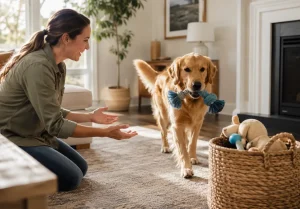
how to teach your dog to put his toys away
Many professional trainers consider mental exercise nearly as important as physical exercise for preventing unwanted behaviors.


Why Do Dogs Love Toys So Much?

Understanding toy behavior makes training easier.
Dogs naturally interact with toys because toys satisfy instincts connected to:
  • Hunting
  • Retrieving
  • Chasing
  • Carrying
  • Chewing
This explains why many dogs carry toys around the house even when nobody is playing with them.

Common Reasons Dogs Carry Toys

ReasonDescription
Retrieval instinctEspecially common in retrievers
Comfort objectSimilar to a child’s favorite blanket
Attention seekingLooking for interaction
ExcitementExpressing happiness
Maternal behaviorMore common in some female dogs
Many owners search:
  • Why does my dog carry around a toy?
  • Why is my female dog whining and carrying a toy?
In some cases, female dogs may display maternal behaviors toward toys, particularly during hormonal changes.
 

Why Do Dogs Like Squeaky Toys?

Squeaky toys remain one of the most popular dog toy categories worldwide.
Behaviorists believe the squeaking sound may mimic sounds associated with prey animals, activating a dog’s natural predatory sequence.
This immediate feedback makes squeaky toys highly rewarding and often very useful during training sessions.

Why Trainers Use Squeaky Toys

AdvantageBenefit
High engagementKeeps attention longer
Instant rewardEncourages participation
Strong motivationUseful for difficult learners
Easy retrievalDogs are more likely to bring them back
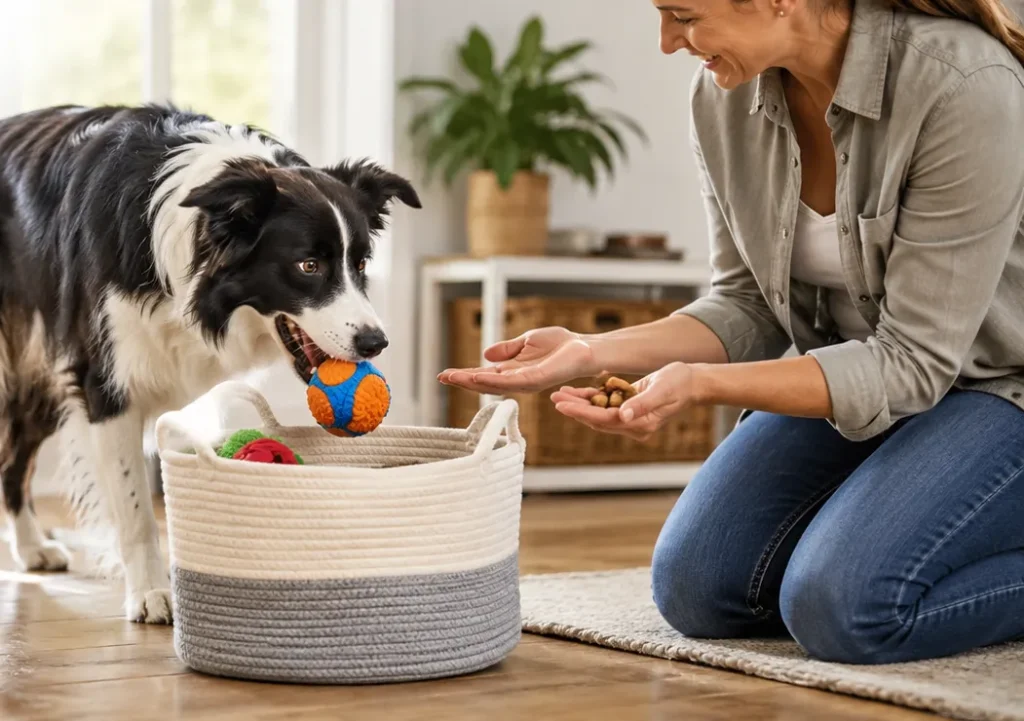
how to train a dog to put toys away

What You’ll Need Before Training

Before teaching cleanup behavior, prepare:
  • A toy basket or storage bin
  • High-value treats
  • Several favorite toys
  • A quiet training space
  • Patience and consistency
Toy baskets with wide openings generally produce faster results because they make successful drops easier.
 

Step 1: Teach “Take It”

Start with one toy.
Hold the toy and encourage your dog to grab it.
The moment they take it:
  • Mark the behavior
  • Give a treat
  • Repeat
Goal:
Dog willingly picks up the toy on command.
 

Step 2: Teach “Hold”

Once the dog takes the toy reliably:
Ask them to hold it for:
  • 1 second
  • 3 seconds
  • 5 seconds
  • 10 seconds
Reward calm holding behavior.
Avoid rushing this step.


Step 3: Teach “Carry”

Now encourage movement.
Ask the dog to carry the toy while walking a few steps.
Gradually increase distance.
This develops the foundation needed for toy cleanup.
 

Step 4: Teach “Drop It”

This is often the most difficult stage.
Many dogs happily pick up toys but refuse to release them.
Reward every successful release.
Keep sessions short and positive.
 

Step 5: Introduce the Toy Basket

Place the basket directly in front of the dog.
When the dog drops the toy near the basket:
Reward.
When the toy accidentally lands inside:
Reward heavily.
Dogs quickly learn that putting the toy inside the basket creates the biggest payoff.
 

Step 6: Increase Distance

Gradually move farther away from the basket.
Soon the dog learns:
  1. Pick up toy
  2. Carry toy
  3. Walk to basket
  4. Drop toy inside
Congratulations.
Your dog is now cleaning up their own toys.
 

Common Problems and Solutions

My Dog Won’t Drop The Toy

Solution:
Trade the toy for treats.
Never force the toy out of the dog’s mouth.
 

My Dog Loses Interest

Try:
  • Squeaky toys
  • Interactive toys
  • Higher value rewards
 

My Dog Destroys Every Toy

This is one of the most searched toy-related questions online.

Why Dogs Destroy Toys

CauseExplanation
BoredomLack of stimulation
TeethingEspecially puppies
Excess energyNot enough exercise
Strong prey driveNatural instinct
AnxietyStress relief behavior
For these dogs, durable chew toys and reinforced interactive toys are often more appropriate than soft plush products.

Best Toys for Teaching Dogs to Put Toys Away

Not every toy works equally well.

Plush Toys

Best for:
  • Puppies
  • Beginners
  • Small breeds
 

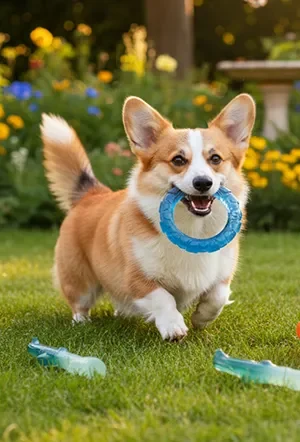
Rope Toys

Best for:
  • Retrieval games
  • Tug rewards
  • Multi-dog households
 

Squeaky Toys

Best for:
  • High motivation
  • Fast engagement
  • Training sessions
 

Interactive Toys

Best for:
  • Mental stimulation
  • Bored dogs
  • Independent play
 

Tough Chew Toys

Best for:
  • Aggressive chewers
  • Power chewers
  • Toy destroyers
 

Which Toy Categories Generate Repeat Purchases?

For pet stores and online pet businesses, toy categories associated with enrichment and training often produce stronger repeat purchasing behavior than purely novelty products.
Toy TypeRepeat Purchase Potential
Interactive ToysVery High
Squeaky ToysVery High
Rope ToysHigh
Plush ToysHigh
Tough Chew ToysHigh
This is one reason trainers, pet boutiques, grooming salons, and online pet retailers frequently stock multiple toy categories rather than relying on a single product type.

Final Thoughts

Teaching a dog to put toys away is much more than a fun trick.
It combines obedience, retrieval skills, mental enrichment, and household organization into one practical exercise.
For pet owners, it creates a cleaner home and a more engaged dog.
For pet businesses, it highlights a growing demand for enrichment toys, interactive products, retrieval toys, and durable chew toys that support both play and training.
As more dog owners focus on mental stimulation and positive reinforcement, toy-based training activities are becoming an increasingly important part of modern pet care.


Aria

Petfairs Writer Introduction:

Hi, I’m Aria—an animal lover rooted in Minnesota with 11 years of hands-on pet parenting experience. Raised in a small town here, I’ve spent years helping neighbors train their cats and dogs, from correcting basic behaviors to fostering better human-pet bonds. Beyond caring for my own furry companions, I’m passionate about rescuing stray animals, dedicating time to their care and rehoming. With a deep understanding of what pets (and their owners) need, I’m here to share practical insights, tailored to Minnesota’s climate and pet owners’ daily lives—all backed by my years of real-world pet care experience.


FAQ

How long does it take to teach a dog to put toys away?
Most dogs can learn the basics within one to three weeks of consistent training. Highly trainable breeds may learn faster, while younger puppies may require more repetition.
Yes. Puppies can begin learning simple cleanup behaviors as early as 8–12 weeks old using positive reinforcement and short training sessions.
Most dogs can start learning toy retrieval and cleanup skills once they understand basic commands such as sit, stay, and drop it.
The easiest method is to break the behavior into small steps: pick up, hold, carry, and drop the toy into a basket while rewarding each success.
Yes. Most dogs can learn this behavior, although retriever breeds, poodles, and herding dogs often learn more quickly.
Dogs may carry toys because of retrieval instincts, excitement, comfort, attention-seeking behavior, or simply because they enjoy interacting with their favorite toy.
Some female dogs display maternal behaviors toward toys, especially during hormonal changes. They may treat a toy like a puppy and become protective or vocal.
Yes, two main risks: 1) Foreign-body ingestion: If a dog tears the toy apart and swallows the squeaker or broken pieces, it can cause gastrointestinal obstruction. 2) Over-arousal/frustration: Highly toy-motivated dogs may become fixated on extracting the squeaker, leading to stress or destructive behavior. Veterinary guidance recommends monitoring toy wear and choosing appropriately sized toys for “destroyer” dogs.
Lightweight plush toys, rope toys, and squeaky toys are usually easiest for dogs to pick up, carry, and place into a toy basket.
Dogs may destroy toys because of boredom, teething, anxiety, excess energy, or strong chewing instincts.
Durable rubber chew toys, reinforced rope toys, and heavy-duty interactive toys are often better choices for aggressive chewers.

Related Blog

why does my dog destroy his toys

How to Train a Dog to Put Toys Away and Clean Up Toys

Learn how to train a dog to put toys away with simple positive reinforcement techniques. Plus tips on toy selection, enrichment, and behavior.
2026 calming dog toys

How to Calm a Dog During a Storm: 2026 Complete Guide for Pet Owners & Businesses

Learn the real science behind dogs’ obsession with squeaky toys (distress call mimicry, auditory sensitivity). Get practical buyer tips for pet businesses & owners only on Petfairs.
Why Do Dogs Like Squeaky Toys

Why Do Dogs Like Squeaky Toys?

Learn the real science behind dogs’ obsession with squeaky toys (distress call mimicry, auditory sensitivity). Get practical buyer tips for pet businesses & owners only on Petfairs.

Table of Contents

Leave a Reply

Your email address will not be published. Required fields are marked *

You May Also Like

us.petfairs

SHIPPED FROM U.S LOCAL WAREHOUSE

Register to Unlock

Wholesale Prices

$10 Off for New Buyers : 6YPYU5KC

✓ Factory-Direct Pricing on Pet Supplies

✓ Low MOQ: Only 1 Carton

✓ Free Nationwide Shipping

Having trouble finding
what you need?

Please select the problem you’re experiencing: